
One wrongful termination lawsuit averages $40,000 before trial. Learn the 4 legal landmines in employee termination, and the defense framework that holds up.
Wrongful termination defense, at-will employment exceptions, termination documentation requirements, WARN Act compliance 2026, EEOC retaliation claims
Why 2026 Shifted the Risk Calculus
The EEOC filed 143 merits lawsuits in fiscal year 2024, a 22% increase from the prior year, with retaliation claims comprising the single largest category at 67.6% of all charges filed. That trend line hasn’t reversed. The agency’s Strategic Enforcement Plan for 2024–2028 explicitly identifies termination-related retaliation as a priority enforcement area, and the NLRB’s expanded definition of protected concerted activity, formalized through a series of ALJ decisions post-2023, has extended that exposure well beyond unionized workforces.
What changed practically: a non-union employee fired after complaining about pay disparities in a group chat now has a viable Section 7 NLRA retaliation argument. That wasn’t a realistic threat five years ago. It is now.
State-level legislative activity adds another layer. Illinois, New York, and California all enacted or expanded just-cause or progressive discipline requirements for specific industries or employer sizes between 2023 and 2025. At-will isn’t dead, but it’s increasingly conditional.
How the Defense Framework Actually Works
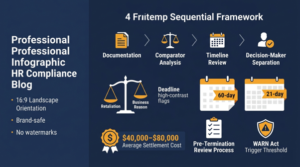
A defensible termination isn’t built at the meeting where you hand someone their final check. It’s built over weeks or months before that. The framework has four load-bearing elements:
|
Element |
What It Requires |
Why It Matters in Litigation |
|
Documented performance record |
Written PIPs, warnings, performance reviews with specific incidents |
Rebuts pretext claims; shows consistent treatment |
|
Comparator analysis |
Evidence of same discipline applied to similarly situated employees |
Defeats disparate treatment arguments |
|
Temporal separation |
Gap between protected activity and termination decision |
Breaks the causation link in retaliation claims |
|
Decision-maker insulation |
The person who decided to terminate had no knowledge of protected activity |
Kills “cat’s paw” liability theory |
Three numbers that define the legal terrain:
- 60 days, WARN Act advance notice requirement for mass layoffs at employers with 100+ employees (29 CFR Part 639); state mini-WARN laws in New York and California impose stricter thresholds
- 300 days, filing deadline for EEOC charges in states with a Fair Employment Practices Agency (most states); 180 days in the rest
- $50,000–$300,000, Title VII compensatory and punitive damages caps, scaled by employer size (15–100 employees to 500+ employees)
The comparator analysis is where most employers fall apart. If you fired a Black employee for tardiness but have a white employee with an identical attendance record who received only a verbal warning, the termination is indefensible regardless of what’s in the policy manual.
Where Employers Keep Losing This
Mistake #1: Terminating within 90 days of a protected event
Consequence: Courts treat temporal proximity, a termination occurring shortly after an employee files an EEOC charge, takes FMLA leave, or reports a safety violation, as direct circumstantial evidence of retaliation, shifting the burden back to the employer to prove legitimate non-retaliatory motive.
Fix: Before finalizing any termination decision, pull the employee’s protected activity history for the prior six months and document in writing why the termination decision was made independently of those events.
Mistake #2: The PIP was written after the decision to terminate was already made
What we see in practice is that managers decide someone is gone, then ask HR to “put together some documentation.” That sequence is catastrophic in discovery. Opposing counsel subpoenas email chains. They find the manager’s note to his director saying “I want her out”, dated three weeks before the first written warning.
Consequence: A retroactive PIP doesn’t just fail to help, it’s evidence of pretext, which in a mixed-motive case can eliminate the employer’s affirmative defense entirely under Desert Palace v. Costa (539 U.S. 90).
Fix: Documentation must precede the termination decision chronologically, with timestamps that hold up to subpoena.
Mistake #3: HR isn’t looped in until the day of termination
A regional manager in Texas decides to fire a warehouse supervisor on a Friday afternoon, calls HR to “let them know,” and expects a separation agreement ready by Monday. The supervisor had filed an internal harassment complaint eight weeks earlier. No one connected those dots.
Consequence: That employer is now defending a retaliation claim where their own internal timeline proves HR had no meaningful role in the decision, which looks exactly like what it was.
Fix: Build a mandatory pre-termination review step into your process: any termination must be reviewed by HR and, for high-risk employees, employment counsel before the decision is finalized.
Mistake #4: The separation agreement release doesn’t comply with the OWBPA
Yes, this feels like yet another compliance burden, especially for employers who’ve used the same severance template for a decade. But if you’re offering severance to employees 40 or older in exchange for a release of claims, the Older Workers Benefit Protection Act imposes specific requirements that most boilerplate releases still get wrong.
Consequence: A non-compliant OWBPA release is unenforceable as to ADEA claims, meaning the employee keeps the severance and can still sue you for age discrimination.
Fix: Any release for employees 40+ must include a 21-day consideration period (45 days for RIF situations), a 7-day revocation window, and specific ADEA claim language, verify your template against 29 CFR 1625.22 before your next separation.
Your 2026 Termination Defense Checklist
- Run a comparator analysis before every termination decision, pull disciplinary records for employees in the same role, same supervisor, same offense category; disparate treatment is the fastest path to a viable lawsuit
- Document the “business reason” in writing before the termination meeting, not after; the decision memo should be dated, signed by the decision-maker, and retained in a separate litigation hold file
- Check WARN Act applicability for any layoff affecting 50+ employees, the 60-day notice clock starts from the date of the layoff decision, not the announcement; state mini-WARN laws may impose earlier triggers
- Verify OWBPA compliance on any release for employees aged 40+, reference 29 CFR 1625.22 directly; do not rely on a template that hasn’t been reviewed since 2020
- Pull the employee’s protected activity log, FMLA leave, EEOC charges, workers’ comp claims, internal complaints, and document temporal separation analysis in writing
- Conduct the termination meeting with two employer representatives present, one to deliver the decision, one to take contemporaneous notes; this defeats later credibility disputes about what was said
- Confirm final pay compliance with state law, California requires final wages on the last day of employment for involuntary terminations; New York requires the next regular payday; federal FLSA has no same-day requirement but state law controls
- Preserve all relevant ESI immediately, emails, Slack messages, performance system records, under a litigation hold notice the moment termination is reasonably anticipated; spoliation sanctions are severe and increasingly common
Every termination that goes sideways in litigation traces back to a gap in this framework. Not the decision itself, the record behind it. The employer who can’t produce a consistent paper trail loses, even when they were right. That’s the part no one wants to say out loud.
SkilSearch Employee Termination Legal Defense webinar covers live walkthrough of compliant separation documentation, OWBPA release requirements, retaliation claim defense strategies, and HRCI/SHRM credit with a downloadable pre-termination review checklist.